Upper-body motion
Streaming arm motion from a human operator to Unitree G1.
GMR
Physical Unitree G1 · independent recording
SMR (Ours)
Physical Unitree G1 · independent recording
Learning human motion. Realizing robot motion.
Learning streaming motion retargeting
for humanoids from human
semantic
Video unavailable. You can explore the demonstrations below.
97.0% motion completion
400 test motions · Frozen Unitree G1 controller · Simulation
0.37 ms per model frame
50 Hz input · Reported model-step timing
No future human frames
Current and past observations → Robot references
The problem & our approach
Retargeting human motion to humanoids requires preserving motion semantics while accounting for the robot's physical constraints. Kinematic pipelines prescribe a robot trajectory through geometric matching, without establishing whether it can be executed under the robot's dynamics. Prior physics-supervised neural methods train bidirectional full-sequence models on physics-refined kinematic trajectories, remaining tied to prescribed kinematic solutions and requiring noncausal context.
We propose SMR, a streaming neural motion retargeter learned from semantic-conditioned physics experts. We convert human motion into robot-aware task-space targets for body landmark positions, orientations, and velocities. Physics experts track these targets directly in simulation under contact, dynamics, and actuator constraints. We train a single strictly causal Transformer on their executed state trajectories that complete the motion and pass semantic and physical validity checks. At each incoming frame, the student uses only current and past human observations to generate a robot motion reference for a downstream whole-body controller.
Experiments demonstrate that semantic-conditioned physics experts generate motion with higher semantic fidelity and physical validity than direct optimization-based retargeting, while the resulting streaming retargeter achieves improved closed-loop performance over kinematic and physics-refined baselines under a common whole-body controller.
02 / From semantics to references

Semantic-conditioned physics experts
Expert policies track semantic task-space targets directly in simulation. Contact, balance, and actuator constraints shape the executed trajectory. Only expert rollouts that pass semantic and physical validity checks become student supervision. IK is used only to initialize expert episodes.

03 / Evaluation
All methods are compared on the same 400 motions in simulation using the same frozen MimicLite whole-body controller. Success means completing a motion without the paper's pelvis-height or projected-gravity failure conditions. Errors include all motions, including failures.
| Reference source | Success ↑ | MPJPE ↓ | E-MPJPE ↓ |
|---|---|---|---|
| GMR | 90.0% | 0.060 m | 0.115 m |
| NMR | 92.0% | 0.057 m | 0.111 m |
| GMR-supervised Student | 91.5% | 0.055 m | 0.111 m |
| GMR-Expert Student | 93.0% | 0.051 m | 0.112 m |
| SMR (Ours) | 97.0% | 0.039 m | 0.080 m |
MPJPE measures tracking error relative to the robot reference; E-MPJPE measures executed wrist and ankle errors relative to the human targets.
At 50 Hz, the SMR model step takes 0.37 ms per frame, compared with 4.87 ms for the warm-started GMR solve under the reported protocol.
04 / Results
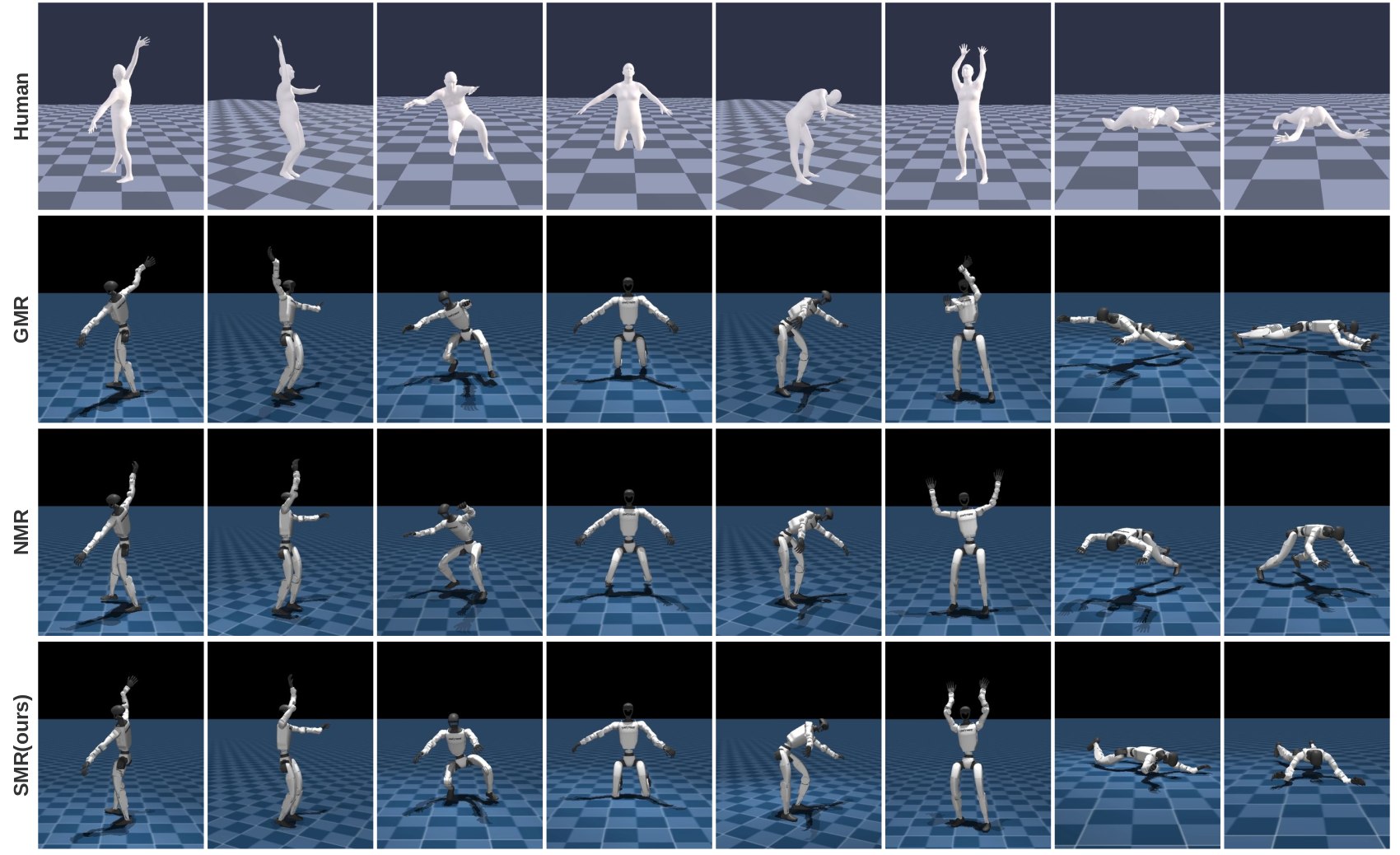
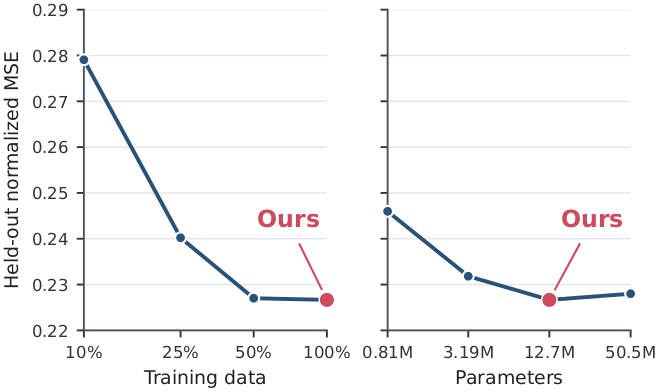
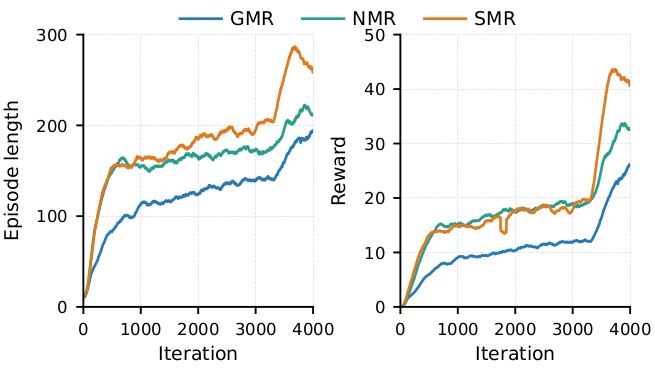
Motion reference comparisons
Four qualitative reference replays compare the source human motion with GMR, NMR, and SMR. These visualize the generated motion references, separately from the frozen-controller completion results above.
Human · GMR · NMR · SMR
Human · GMR · NMR · SMR
Human · GMR · NMR · SMR
Human · GMR · NMR · SMR
Videos retain their embedded panel labels. The bottom-right NeuralRetarget panel denotes SMR. Playback timing is preserved from the supplied clips.
Streaming / physical deployment
Human motion is translated into robot references for execution through MimicLite. The recordings below compare GMR-driven and SMR-driven execution across three demonstrations.
GMR and SMR are independent recordings. Each clip has its own playback controls; they are qualitative examples, not synchronized trials or an additional success-rate evaluation.
Streaming arm motion from a human operator to Unitree G1.
Physical Unitree G1 · independent recording
Physical Unitree G1 · independent recording
Lower-body transitions with coordinated arm motion.
Physical Unitree G1 · independent recording
Physical Unitree G1 · independent recording
Upper-body motion while the robot holds a bag.
Physical Unitree G1 · independent recording
Physical Unitree G1 · independent recording
06 / Citation
@article{gu2026smr,
  title         = {SMR: Learning streaming motion retargeting for humanoids from human semantic},
  author        = {Gu, Chun and Zhang, Juntong and Li, Jingyu and Zhang, Li},
  journal       = {arXiv preprint},
  year          = {2026}
}